Build, architect, lead: the 18 signs of AI-native marketing leaders.

More than 50 marketing leaders went through our Agentic CMO Accelerator, learnt agentic skills and started leading AI transformation in their companies with confidence. What makes these leaders AI-native?
Most of the leaders I meet use AI every day. Far fewer have built an agent, and fewer still have a whole team working from one shared system. That’s the gap between using AI and being AI-native.
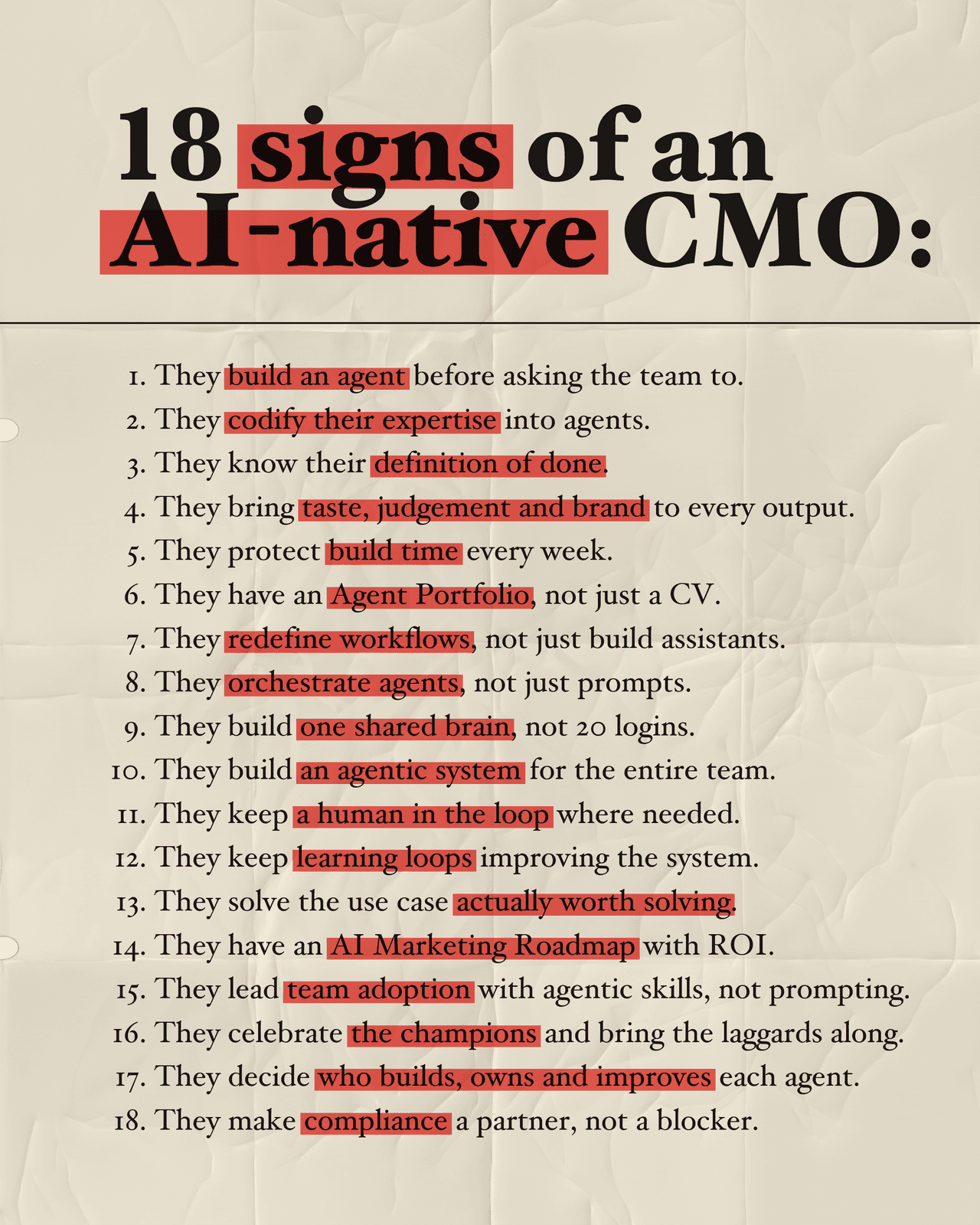
I see the AI-native CMO role as three pillars: build, architect and lead. Here are the 18 signs I see again and again, six for each pillar.
Build: you can’t lead what you’ve never built
Building is how you start. And building is how you keep up.
1. They build an agent before asking the team to.
It’s hard to imagine what agentic AI can do for your function until you’ve built an agent yourself. One build changes how you see every workflow you own.
2. They codify their expertise into agents.
Their judgement on a brief, a campaign or a positioning call stops living in their head and starts living in a system the team can use.
3. They know their definition of done.
An agent is only as good as the standard you give it. AI-native CMOs can say exactly what good looks like before the first draft arrives.
4. They bring taste, judgement and brand to every output.
AI makes output cheap. Your standards make outcomes valuable.
5. They protect build time every week.
Learning needs protected time. The leaders who make progress put it in the diary and keep it there.
6. They have an Agent Portfolio, not just a CV.
The agents they’ve built say more about what they can do than any job title.
You can’t lead agentic AI without deeply understanding the technology.
Architect: from one builder to the whole team
It’s easy to build a personal agentic system. The real challenge is architecting the multiplayer version.
7. They redefine workflows, not just build assistants.
An assistant makes one task faster. Redesigning the workflow asks whether the task should exist at all, and who (or what) should do it. You can’t have a faster horse. You need to build a car.
8. They orchestrate agents, not just prompts.
One prompt solves one task. Orchestration connects agents so a whole workflow runs, with people approving at the moments that matter.
9. They build one shared brain, not 20 logins.
Twenty people with twenty separate AI accounts end up with twenty versions of the brand. One shared brain means every human and every agent works from the same source of truth.
10. They build an agentic system for the entire team.
Personal is a workflow. Team-wide is an orchestration.
11. They keep a human in the loop where needed.
Not everywhere, and not nowhere. They decide where human judgement adds the most and design the system around it.
12. They keep learning loops improving the system.
Feedback goes back into the context, so the system gets better every week instead of drifting.
Personal is a workflow. Team-wide is an orchestration.
Lead: team adoption is a leadership challenge
Team adoption is the biggest challenge. And it’s a leadership challenge, not a technology one.
13. They solve the use case actually worth solving.
Use case first. Tool second. Measurement always.
14. They have an AI Marketing Roadmap with ROI.
They can show the board which use cases come first, what each one is worth and when it pays back.
15. They lead team adoption with agentic skills, not prompting.
Prompting gets a team chatting with AI. Agentic skills get a team building and running agents.
16. They celebrate the champions and bring the laggards along.
Change management is really fear management. When skills go up, anxiety goes down.
17. They decide who builds, owns and improves each agent.
An agent without an owner stops improving the week after launch.
18. They make compliance a partner, not a blocker.
Legal and compliance are in the room from the start, so agents are built safely the first time.
Team adoption starts with self-adoption.
Your questions on the AI-native CMO
The LinkedIn post started a great conversation. Here are the questions that came up most, with my answers.
Does a CMO really need to build agents?
You don’t need to become an engineer. But you do need to build at least several agents yourself. That’s how you learn what agents are good at, where the risks sit and what your team is about to go through. Some leaders keep building. Others build simple assistants, then architect and lead while their team or AI engineers build the complex agents.
Can you be AI-native in a regulated company?
Regulated companies are on their journey to being AI-native, the same as all other companies. I train marketing leaders at S&P Global Ratings, Wood Mackenzie and State Street, and they take risk more seriously than anyone. Being AI-native doesn’t mean handing your brand to autonomous agents. It means understanding the technology well enough to decide where agents belong, where they don’t and which guardrails they need. That’s why sign 18 matters so much. In the Agentic CMO Accelerator, week one is privacy and safety, before anyone builds anything.
Won’t the team copy your set-up and produce average work?
Only if they copy the tools without your judgement. That’s why signs 2 and 3 come so early: codify your expertise and your definition of done, so the system carries your standards and not just your prompts. AI output without your input is average.
Where does the customer’s voice fit?
Right inside the shared brain. Brand guidelines and strategy docs aren’t enough on their own. Customer calls, reviews and research belong in the context too, or every agent ends up sounding like every other agent.
The next step is a messaging synthetic persona. Not a generic “act as a CMO” prompt, but a panel of personas built from your first-party data: customer interviews, sales calls, surveys and community posts. Every message, campaign and landing page gets tested against your customers’ own words before it goes live.
What it looks like in a real team
Pia Villa joined Cohort 1 of the Agentic CMO Accelerator in April. Then she drove adoption across a 30-person team, with regular AI training and multiple agents launched: landing page automation, an OKR agent, email automation and performance marketing reporting.
The hardest part of AI isn’t building agents. It’s getting a team to use them. That’s exactly what Pia did, and now she’s teaching alongside me as an AI Coach.
Start with one action
You don’t need all 18 by January. Pick the one that would make the biggest difference to your team, and put it in your 2027 plan. For most leaders, it’s the first one: build an agent before you ask the team to.
Build. Architect. Lead. In that order.
Want to make this leap inside your company? Senior marketing leaders from ZOE, AG1, VEED, Essity and S&P Global Ratings are building agents and leading agentic transformation inside theirs, as graduates of the Agentic CMO Accelerator. Join the next cohort to start yours.